Alexander Technique and Stress

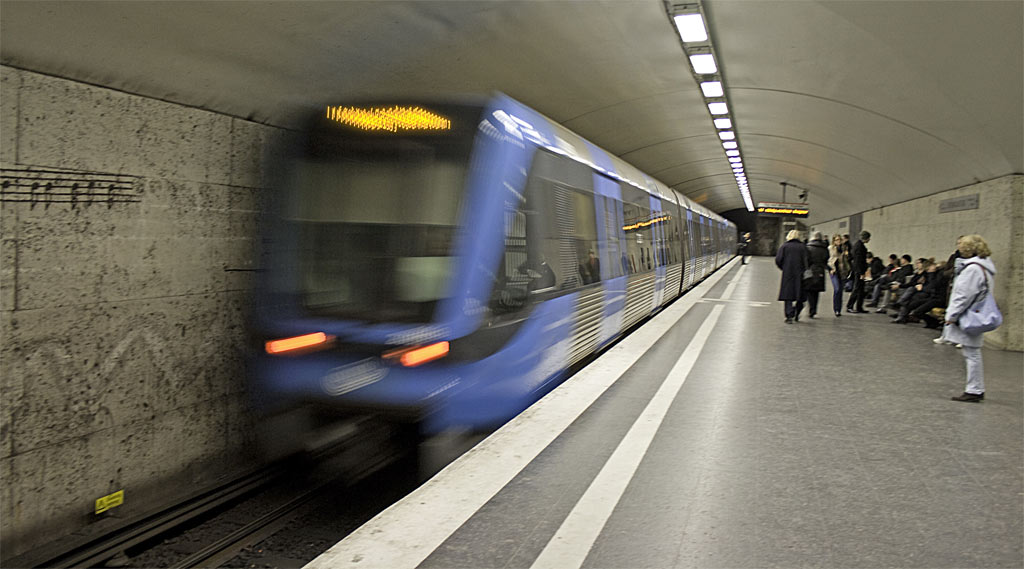
As I was riding the subway on my way to teach some Alexander Technique lessons, an announcement was made over the PA system: Gr Grbrwr Kr gaggar. Sometimes that’s what announcements sound like in the NYC subway system, usually when you need to hear them. When you don’t need to hear them they’re crystal clear and loud enough to make your ears bleed. But I digress, already.
When this announcement was repeated though, I heard “because of an earlier incident, all trains into Manhattan will be delayed.” I was a bit late even before this incident (doughnut run?).
After spending some quality time being annoyed, I made a conscious decision. That was my first step in applying a principle of the Alexander Technique, the principle of inhibition. I decided to just stop my habitual thinking and become aware.
I became aware of my breathing and my neck tension. I wanted to discover if I was using more tension than was necessary. For me, the answer is often ‘yes’. I was able to let it go.
As soon as I became aware of my breathing, it changed.
It became fuller and slower. I looked for extra tension in my jaw, the corners of my mouth, my forehead and my legs. Are you able to notice any extra tension now, as you’re reading this?
I slowed down. I changed my reaction to the situation, and now I’m writing this. It took only a few minutes to notice and make some big changes. Awareness, inhibition and direction can be cultivated, and they’re great tools.
Mark Josefsberg-Alexander Technique NYC
917.709.4648
Related posts:


Hi Mark,
I also like this stopping of habitual thinking. In my opinion this ’stopping’ is already the main part. Becoming aware about it and decide just to stop. You went on thinking about your body in a more constructive way. It usually leads me first to questioning the underlying concepts e.g. “OK, I’m late, so I’m angry or whatever, but does this actually help me in any way? Actually I (now) can’t do anything about being late so accept the fact and enjoy life…” By changing this concept my body tends to follow into o more open way of use. In this way one can also learn a lot about habitual reactions and gradually change them.
All the best,
Daniel
Hi Daniel,
This ’stopping’ business is a crucial element of the Alexander Technique. The gap between a stimulus and a response gives us a chance to do something different. Alexander called what occurs during this gap ‘inhibition’.We learn to inhibit. It’s an integral part of the technique, part of the three pillars: Awareness, Inhibition and Direction.
Mark
Leave a comment!
Alexander Technique »
Welcome To Alexander Technique NYC!
Mark Josefsberg- Nationally Certified Alexander Technique Teacher offering Alexander Technique lessons in New York City. Fix your posture, reduce your back pain, neck pain, stress and more with the Alexander Technique.
For locations and fees please see the ‘FAQ’s’ page (on top.)
“With good humor, specificity, and charm, Mark makes a challenging technique accessible and fun!” -Kyra Sedgwick
“I really enjoyed our Alexander Technique sessions, learned a lot, felt lighter, more balanced and my neck pain is better. You have a true healing presence and great knowledge and skill.”
-Martin Ehrlich M.D., M.P.H. Medical Director, Beth Israel Continuum Center for Health and Healing.
To schedule a session call Mark: (917) 709-4648 or email: Mark@MarkJosefsberg.com
Neck Pain »
How To Reduce Neck Pain
I have a stiff neck. We say we have a stiff or sore neck, as if someone gave it to us and now it’s ours. In Alexander Technique terms it might be more accurate to say “I’m stiffening my neck.” Of course if you say it that way you sound insane…
Posture »
Alexander Technique Posture Directions
Alexander Technique Directions
I wish to free my neck … so that
My head can move forward and up…so that
My torso can lengthen and widen and…
My legs can move away from my torso and…
My shoulders can release out the sides.
Alexander Technique directions act as verbal, or neuro-linguistc cues. They tell us where we want to go, which is often upward, outward, into expansion. Up, down, and out. Head up, feet or sit bones down, shoulders out, legs away…
Stress »
Over Learning The Alexander Technique
The Alexander Technique has been described as a reeducation technique or psycho-physical reeducation. It is also a technique to be overlearned, and not only because you learn it over other things (bad habits of either movement or stillness), but when it comes to the Alexander Technique we need to be overeducated; we need to overlearn it so that we can use it under duress, much like a musician practices over and over to be able to execute music under stress…
FREE ENEWSLETTER. Receive Free online lessons, tips and useful ideas about the Alexander Technique. They'll arrive every two weeks. "The emails always seem come at the right time; When I'm slumped the worst! Thanks!" -Laurie R.
What is the Alexander Technique?
Alexander Technique Video
Why Take Alexander Technique lessons?
2. Get lasting relief for your back pain and neck pain. (reported by The British Medical Journal)
3. Reduce your anxiety and stress by releasing unnecessary tension.
4. Carry yourself with confidence, and present yourself with poise and strength.
5. Breathe easier and have a stronger voice.
6. Why Alexander Technique lessons?
Because we live in New York!
Mark Josefsberg-AmSAT and ACAT Certified Alexander Technique Teacher
Mark@MarkJosefsberg.com
(269)-POSTURE
or 917.709.4648
Categories
Archives
Blogroll
Tags
acting actors Alexander Technique Alexander Technique Lessons Alexander Technique Lessons.#1 Alexander Technique Lessons.#2 Alexander Technique Lessons.#3 Alexander Technique Principles Alternative Medicine Awareness Back Pain bad posture Balance Being Present bodywork books Breathing computer posture craniosacral therapy Directions driving Ergonomics exercises good posture Happiness Holistic Inhibition light-touch bodywork Meditation music musicians Neck Pain New York Times observation oppositions pain Poise Posture side effects slumping Stress Tension