Alexander Technique Teacher NYC
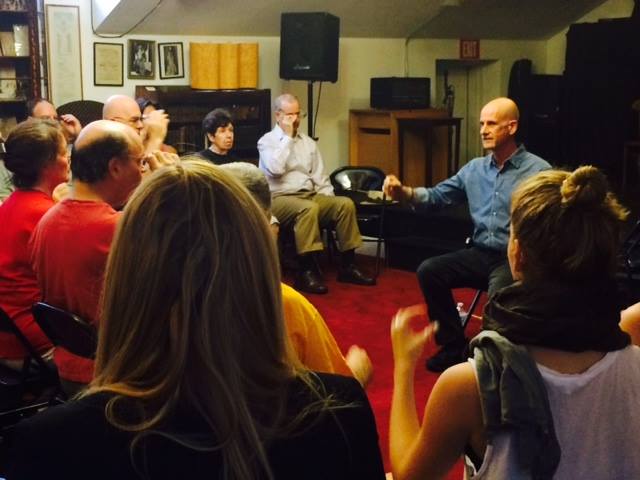
What kind of person takes the three year course to become an Alexander Technique teacher? At first, I believe, it’s the same type of person who decides to take a few Alexander Technique lessons, and there’s no ‘type’ of person. To become a certified Alexander Technique teacher, you enter an Alexander Technique training school. You enter school after studying the Technique with a certified Alexander Technique teacher for some time. The usual requirement is to take more than 30 lessons before taking several ‘audition’ lessons to be accepted into a teacher training program.
Trainees enter school for the same reason students take lessons, which varies. Often people start lessons because they have pain or discomfort in the back, neck, shoulders or hands. Sometimes they seek out an Alexander Technique teacher because of headaches, shallow breathing, bad posture both while at and away from the computer, or to reduce stress and tension. People have told me they’ve seen themselves in a picture or video, and are surprised by the way they appear. People will look for an Alexander Technique teacher because they want to present themselves with more confidence in their personal or business lives. Musicians study the Alexander Technique to improve their performance, or to rescue a career threatened by neck, back or hand pain.
The reasons for searching for an Alexander Technique teacher are as varied as the people coming for lessons, or the benefits they could receive. People sometimes see starting results, and decide to stay with the technique for an extended period of time. A point may come where a few of them may want to be even more serious about the technique. They may think “if one or two fortyfive minute lessons a week are doing this much good, imagine three hours a day, five days a week for three years!” That’s the training course, and that’s my story.
I have had a few students who went on to become certified Alexander Technique teachers themselves. That really frees my neck.
Mark Josefsberg-Alexander Technique NYC
Call Mark@ 269-POSTURE
or 917.709.4648
TWITTER-AlexanderTechNY
Related posts:


So are the Technique teachers good enough to perform on themselves?
Hi Alfred,
Thanks for writing.
Most of the three year training to become an Alexander Technique teacher is dedicated to ‘working on yourself’. I don’t think you have to be good enough to work on yourself; you just work on yourself. After one 45 minute lesson, a student begins to work on his/her self. This may start with ‘freeing your neck’. You don’t have to be good at it; you just do it. Does that make sense to you? Either way, I’d like to hear from you.
Mark
Leave a comment!
Alexander Technique »
Welcome To Alexander Technique NYC!
Mark Josefsberg- Nationally Certified Alexander Technique Teacher offering Alexander Technique lessons in New York City. Fix your posture, reduce your back pain, neck pain, stress and more with the Alexander Technique.
For locations and fees please see the ‘FAQ’s’ page (on top.)
“With good humor, specificity, and charm, Mark makes a challenging technique accessible and fun!” -Kyra Sedgwick
“I really enjoyed our Alexander Technique sessions, learned a lot, felt lighter, more balanced and my neck pain is better. You have a true healing presence and great knowledge and skill.”
-Martin Ehrlich M.D., M.P.H. Medical Director, Beth Israel Continuum Center for Health and Healing.
To schedule a session call Mark: (917) 709-4648 or email: Mark@MarkJosefsberg.com
Neck Pain »
How To Reduce Neck Pain
I have a stiff neck. We say we have a stiff or sore neck, as if someone gave it to us and now it’s ours. In Alexander Technique terms it might be more accurate to say “I’m stiffening my neck.” Of course if you say it that way you sound insane…
Posture »
Incorporating The Alexander Technique
“How can I incorporate the Alexander Technique into my life?” I hear this question, and versions of it, frequently at Alexander Technique lessons. It’s really a great question and gets to the heart of the matter of the benefits of the Alexander Technique.
The Alexander Technique is done as you think about it. If you’re thinking about the principles of the Alexander Technique, you’re doing the technique, or you’re practicing the technique, or you’re performing the technique, or you’re applying the technique, or you’re incorporating the Alexander Technique into your life.
As an Alexander Technique teacher I emphasize awareness of initiating movement; how you start actions like moving your hands, initiating walking, so…
Stress »
Over Learning The Alexander Technique
The Alexander Technique has been described as a reeducation technique or psycho-physical reeducation. It is also a technique to be overlearned, and not only because you learn it over other things (bad habits of either movement or stillness), but when it comes to the Alexander Technique we need to be overeducated; we need to overlearn it so that we can use it under duress, much like a musician practices over and over to be able to execute music under stress…
FREE ENEWSLETTER. Receive free online lessons, tips and useful Alexander Technique concepts and ideas. You'll also receive information about my Free Alexander Technique group classes. "The emails always seem to arrive at the perfect time-when I'm slumping the worst! -Laurie R.
What is the Alexander Technique?
Alexander Technique Video
Why Take Alexander Technique lessons?
2. Get lasting relief for your back pain and neck pain. (reported by The British Medical Journal)
3. Reduce your anxiety and stress by releasing unnecessary tension.
4. Carry yourself with confidence, and present yourself with poise and strength.
5. Breathe easier and have a stronger voice.
6. Why Alexander Technique lessons?
Because we live in New York!
Mark Josefsberg-AmSAT and ACAT Certified Alexander Technique Teacher
Mark@MarkJosefsberg.com
(269)-POSTURE
or 917.709.4648
Categories
Archives
Blogroll
Tags
acting actors Alexander Technique Alexander Technique Lessons Alexander Technique Lessons.#1 Alexander Technique Lessons.#2 Alexander Technique Lessons.#3 Alexander Technique Principles Alternative Medicine Awareness Back Pain bad posture Balance Being Present bodywork books Breathing computer posture craniosacral therapy Directions driving Ergonomics exercises good posture Happiness Holistic Inhibition light-touch bodywork Meditation music musicians Neck Pain New York Times observation oppositions pain Poise Posture side effects slumping Stress Tension